Runware’s Factory Bet: Can Your AI Supplier Keep Up?
▶ Watch the video version of this article
An AI service can answer your invoice request while the invoice itself never gets drafted. If your business depends on that workflow, Runware’s plan to manufacture AI data centers matters—but not in the way a factory headline might suggest. The useful question is whether your supplier’s capacity turns into completed, recoverable work.
What Runware is building—and what remains a target
Runware announced on October 30, 2026 that it plans to manufacture modular AI data centers in a new European factory. Factory production, installed computing capacity, and reliable service are three different milestones; the announcement does not make them interchangeable.
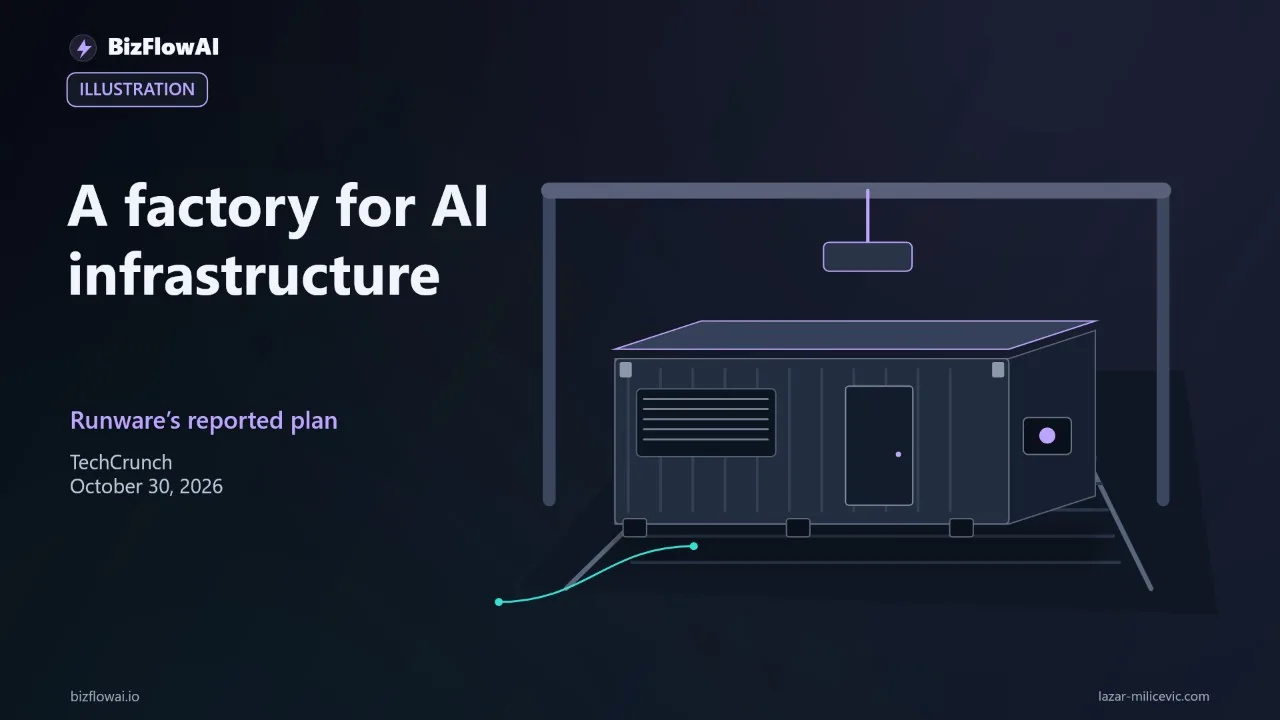
The planned units, called Sonic Pods, come in two formats: a 1 MW data center in a 20-foot container and a 2 MW data center in a 40-foot container. Runware says factory-produced units will receive electrical, cooling, and connectivity checks before shipment, including cooling tests at full load. That is the practical idea behind the factory: make and test repeatable units rather than treat every facility as a separate build.
The production figures need careful labels. Runware plans to begin production at the new factory in Q1 2027. It says the line is designed to manufacture the equivalent of up to 30 MW of compute facilities per day and aims for 10 GW of annual manufacturing capacity by the end of 2027. Neither figure is capacity already manufactured, connected to power, or serving customers.
Runware also says its existing European assembly operation is assembling 41 Sonic Pods by the end of 2026. That does not mean all 41 are deployed. Its stated 397 MW site pipeline, and a planned expansion to 1.2 GW within six months, describe another stage again: prospective sites are not running workloads.
The most easily misread figure is under 48 hours. Runware describes that as the target to install and commission an individual pod at a prepared site. It excludes manufacturing and site preparation. It is not a promise that a business can order a pod and receive a working AI service two days later.
There is some operating history, but its scope matters. Runware says Sonic Pods have served its own inference workloads since Q1 2026 and claims “100% uptime” for the longest-running current version. That is a company-reported claim about a particular pod version, not an independently audited guarantee for the service or proof of future factory output.
Follow the dependency to your actual workflow
More manufactured infrastructure could help an AI supplier add capacity, but it does not automatically lower your bill or complete your business task. A small business buys the downstream service: an API response that must pass through its own workflow before a customer sees a result.
Consider an invoice request arriving by email. An automation reads the message, identifies the customer, extracts the requested work, prepares a draft in the accounting system, updates the CRM, and flags missing details for a person. If that process currently consumes two to four hours of manual work a day, it is a reasonable candidate for workflow automation.
But the AI request is only one step. A fast, successful model response can still produce the wrong customer match. A correct extraction can fail when the accounting integration is unavailable. A retry can create a duplicate draft if the workflow does not recognize that it already acted on the email.
That distinction also applies to cost. Runware advertises $1 million per usable MW per year for a pod-only Vera Rubin service, excluding compute hardware and electricity. It is not the total cost of running AI, and it does not tell a small business what its invoice automation will cost per completed invoice.
Track two outcomes separately:
| Layer | Question to answer |
|---|---|
| AI service | Did the request complete, and what time and cost did your provider record? |
| Business workflow | Did the correct customer get exactly the intended draft, or a visible exception for review? |
A supplier can improve the first row without fixing the second. Your monitoring should show both.
Run a small test before trusting more capacity
I suggest starting with a small set of representative inputs through a version of your workflow that cannot send customer messages or create live invoices. This is a way to begin testing, not an official threshold; check your provider’s documentation for any service-specific testing guidance. The goal is not to prove production reliability. It is to define success, expose incorrect business actions, and record what happens when the AI service is unavailable.
Use anonymized copies of real request patterns where possible. Include a straightforward request, one with missing information, and a duplicate. Add cases your team actually struggles with—for example, a customer name that resembles another record or an email that mentions several services. Keep the accounting connection in draft-only mode if your tooling supports that safely; otherwise, replace it with a test adapter that records the proposed action without writing to the live system.
For each case, record these four fields independently:
| Input | AI request completed? | Elapsed time | Recorded AI cost | Intended business action correct? |
|---|---|---|---|---|
| Clean request | Record result | Record measurement | Record provider charge, if available | Check customer and draft |
| Missing detail | Record result | Record measurement | Record provider charge, if available | Check that it requests review |
| Duplicate request | Record result | Record measurement | Record provider charge, if available | Check that no second draft is proposed |
| Simulated timeout | No | Record measurement | Record charge only if shown | Check queue and notification |
Fill the table with measurements from your own run, not a supplier’s infrastructure targets. If your provider does not expose a per-request charge, mark it not available rather than estimating one.
Then make one test request return a timeout without calling the AI service. Inspect the handoff: Is the job still visible? Who is notified? Can it resume without repeating an accounting action? A small test will not establish an uptime percentage, but it can reveal whether your definition of “working” stops at the model response.
Make retries safe before you need them
A retry should repeat an unfinished step, not repeat a completed business action. Store a stable identifier for each incoming request and a separate record of any draft you create; on recovery, check those records before writing to the accounting system again.
Runware’s API error documentation makes the supplier-side part concrete. HTTP 429 can mean either an over-capacity model queue or an exceeded organization rate limit; HTTP 503 indicates temporary unavailability. Runware recommends exponential backoff for transient failures and observing a specified retry wait. Its docs also say to log the error message and taskUUID to help diagnose failures, and that tasks within one request can succeed or fail independently.
Those behaviors call for more than “retry the whole workflow.” A minimal durable record might look like this:
CREATE TABLE workflow_jobs (
    source_message_id TEXT PRIMARY KEY,
    state TEXT NOT NULL,
    provider_task_uuid TEXT,
    accounting_draft_id TEXT,
    last_error TEXT
);
The primary key prevents two rows in this table from having the same source_message_id; whether your application processes the message again depends on its code. Check your database’s official constraint documentation and your retry logic when implementing this. The key does not, by itself, guarantee exactly-once behavior across your database and an external accounting system. If the accounting system creates a draft but your application crashes before saving accounting_draft_id, a blind retry could still create another. Before retrying that write, reconcile against the accounting system or use its idempotency support if it provides one.
Keep the states meaningful: pending AI work, awaiting human review, ready to draft, drafted, and failed-needs-attention are more useful than a single success flag. Preserve the original request, the proposed action, and any supplier error in the job record. For a batch with independently failing tasks, inspect each task’s result before marking the batch complete.
This is where business automation becomes an operating system rather than a chain of prompts. When a supplier cannot respond, the customer’s work should remain visible and recoverable.
Judge the supplier at the service boundary
Watch Runware’s factory for evidence of manufactured units becoming commissioned capacity and then dependable service. For your own buying decision, measure the API and the completed workflow you use—not the factory’s planned output.
That means keeping separate records for supplier response failures, rate-limit events, elapsed time, recorded cost, and incorrect or incomplete business actions. If your workflow depends on an AI agent, test the permissions and downstream integrations as deliberately as the model call. More supply cannot correct an agent that selects the wrong account or writes without review.
Runware’s plan is worth following because repeatable manufacturing and pre-shipment testing could make infrastructure deployment more predictable. The unresolved question is how consistently that output becomes useful service. You do not need to answer it from a headline. You can test the dependency you control now and revisit your supplier choice when you have measurements from your own workload.
A practical approach to this
The approach I recommend tracks the incoming request, the proposed action, the human handoff, and recovery after a failure. It keeps an AI supplier’s infrastructure claims separate from whether the small business workflow actually finished the job.
Want more like this?
Lazar Milićević is a senior engineer who builds AI automations for solopreneurs and small teams.
Frequently asked questions
What is Runware’s prefabricated AI data center plan?
TechCrunch reports that Runware is building a factory to produce prefabricated AI data centers on an assembly line. The idea is to make infrastructure production more repeatable than building each facility as a separate project. The report summary leaves open whether Runware can deliver working capacity repeatedly at scale. Its 48-hour headline framing does not establish that an entire project can go from an empty site to useful computing in two days.
Why does Runware’s factory plan matter for businesses using AI services?
Businesses usually buy access to AI services rather than data centers. If factory production eventually lets suppliers add computing capacity more predictably, businesses that depend on those services could benefit. That is a possible outcome, not a measured result of Runware’s announcement. More infrastructure alone does not establish lower prices, faster responses, or fewer failures for a particular workflow; those outcomes need evidence from the service a business uses.
How do I test whether an AI automation is reliable enough for my workflow?
Choose ten representative inputs, including a clean request, one with missing information, and a duplicate. Run anonymized copies through a test version that cannot send customer messages or create live invoices. For each case, record whether the AI request completed, its duration, its recorded cost, and whether the business action was correct. Then simulate a timeout and check whether the job queues, notifies someone, and resumes without duplicating the action.
When should I use service-level tests instead of infrastructure news to judge an AI workflow?
Use service-level tests when deciding whether an AI workflow works for your business. An infrastructure announcement concerns a supplier’s capacity plans; it does not show that your invoice draft reaches the accounting system correctly or that a failed request can recover. Test the service and the business action separately. Ten cases will not prove production reliability, but they can expose missing success criteria and an unclear recovery path.