Mistral Le Chonk: Does a Lower Score Mean Higher Cost?
Your invoice integration is broken, you can't justify a full-time developer, and a new trillion-parameter coding model just landed with a lower overall score than two Chinese rivals. Which number tells you what it costs to get your integration fixed? None of the headline ones do. Here's how I'd separate the release from the business decision, and the one test I'd run before touching your automation stack.
What the score of 26 actually measures
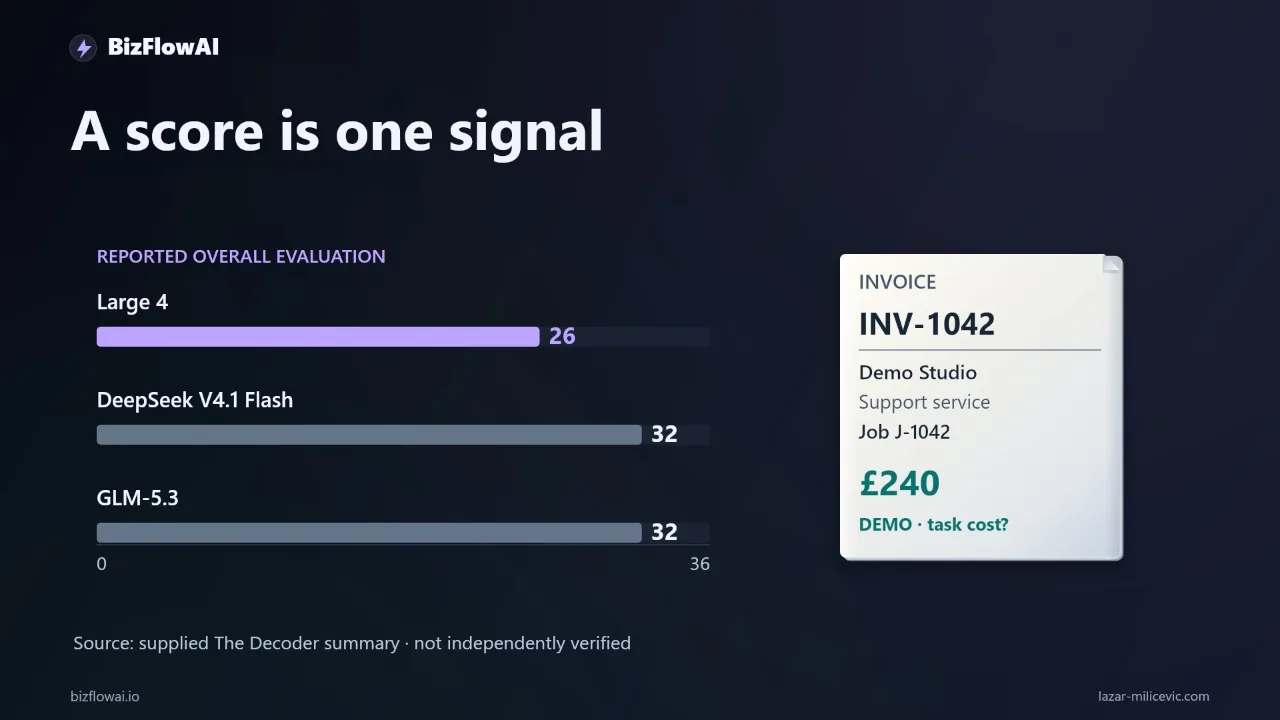
On Artificial Analysis' Intelligence Index, Mistral Large 4 ("Le Chonk") scores 26, while DeepSeek V4.1 Flash and GLM-5.3 each score 32, according to The Decoder. That is a general-intelligence composite, not a measure of how well the model repairs your code.
Two details keep you from misreading it:
- The 26 is on Intelligence Index v5, where the preview scored 25. Earlier figures of 38 came from an older scale and are not comparable. A drop from 38 to 26 is not a regression.
- Artificial Analysis rated the model at its high reasoning setting, so the score reflects that configuration.
The coding picture is closer. On the Artificial Analysis Coding Agent Index, Large 4 ranks second among open-weight entries, one point behind GLM-5.3. That gap is too small for me to call a real difference, and the index scores the model together with the agent software around it, not the model alone. Mistral's own claims (Terminal-Bench 4.0 at 41%, plus numbers on FrontierCode and others) are vendor-reported. On Terminal-Bench, Artificial Analysis's own assessment reports 25%. Don't swap one for the other.
One more number worth knowing: on AA-Omniscience v1.1, Large 4 has a 28% hallucination rate (down from 41% for the preview), but its accuracy is only 26%, against 40% for DeepSeek V4.1 Flash 1017. For code that touches billing, "confidently wrong" is the failure mode that costs you.
Does a lower score mean higher cost? Not in this data
The premise in the title doesn't hold up cleanly, and I'm not going to fake a tidy answer. Here is what the sources do say:
- Artificial Analysis reports $2.06 per Intelligence Index task for the final model, down from $5.54 for the preview, a 63% reduction.
- The final model uses an average of 82,000 output tokens per task, down from 135,000 (a 39% cut).
- On the Coding Agent Index, Large 4 uses 8.5 million tokens per task versus GLM's 15.9 million, about 47% fewer.
- Per Implicator's analysis, DeepSeek and MiMo score higher than Large 4 at lower cost per task. So the lower-scoring Mistral model is not the cheapest option on that measure.
I could not find Artificial Analysis cost-per-task figures for DeepSeek V4.1 Flash or GLM-5.3, so I won't put dollar amounts on the Chinese rivals. What the data supports: a lower score doesn't automatically mean a higher cost, and it doesn't mean a lower one either. Also note the $2.06 is for Intelligence Index tasks, not Coding Agent Index tasks, so it isn't a coding-task price.
Most important, the reported per-task and API costs do not include self-hosting or human review. That omission is the whole point of the next section.
The price list, and why tokens aren't the bill
Mistral's official model card lists API pricing for mistral-large-4 (also mistral-large-4-0), released 2026-10-06:
| Token type | Price per million tokens |
|---|---|
| Input | $0.70 |
| Cached input | $0.07 |
| Output | $2.10 |
Per VentureBeat, that's roughly half the earlier $1.36 input / $0.14 cached / $4.18 output. The pricing history is murky: a promotional discount applied during the preview, so check the current price on Mistral's pricing page before you budget. Third-party platforms may charge differently from Mistral's own rates.
Cheap tokens are not a cheap fix. Here's an illustrative example with round numbers, not a measurement of this model:
Attempt 1: model patch    -> fails the timeout+retry case
Attempt 2: model patch    -> passes, but changes invoice numbering
Attempt 3: model patch    -> passes all four cases
Human review: 40 minutes at your hourly rate
The model spend across three attempts might be pennies. The 40 minutes of your time is the real line item. A model that burns 47% fewer tokens but needs a second round of review isn't cheaper. That's why I track spend, elapsed time, and review minutes as three separate figures.
The failure that makes a cheap call expensive
Here's the scenario that matters if you run a small business. A request arrives, your adapter converts a CRM record into the format your invoicing system accepts, and the first call creates an invoice. The response times out. The system retries and creates a second invoice. Now you have a customer problem, an accounting correction, and an audit trail to untangle.
The standard fix is an idempotency key: derive a stable key from the source record, and refuse to create a second invoice for a key you've already processed.
import hashlib

def idempotency_key(crm_record: dict) -> str:
    # Stable across retries: built from fields that identify the invoice,
    # never from timestamps or random IDs.
    raw = f"{crm_record['customer_id']}|{crm_record['order_id']}|{crm_record['total']}"
    return hashlib.sha256(raw.encode()).hexdigest()

def create_invoice(crm_record, accounting_client, store):
    key = idempotency_key(crm_record)
    existing = store.get(key)
    if existing:
        return existing  # repeat request -> same invoice, no duplicate

    invoice = accounting_client.create(crm_record, idempotency_key=key)
    store.put(key, invoice)
    return invoice
This is a sketch of what I'd want the model to produce or improve, not output from Le Chonk. The hard parts are exactly the ones a model can get subtly wrong: what goes into the key, what happens if store.put fails after the remote call succeeds, and whether different invoices still process normally.
The one test I'd run before switching
This is a proposed test, not a result I've measured for this model. Take a small integration you already own, strip customer data and credentials, and give the model one task: repeated requests for the same invoice must produce one invoice, while different invoices must still process normally.
Give Le Chonk and your current model the same starting code, instructions, tools, and retry limit. Point both at a sandbox accounting endpoint. Then check four cases and inspect the resulting records, not the model's explanation:
cases:
  - name: normal_request
    expect: one invoice created
  - name: repeated_request
    expect: still exactly one invoice
  - name: timeout_then_retry
    expect: exactly one invoice, no duplicate
  - name: missing_required_field
    expect: rejected cleanly, zero invoices created
record_per_model:
  - model_spend_usd
  - elapsed_minutes
  - human_review_minutes
  - cases_passed_of_4
Keep those figures separate until the end. Real numbers, no estimates: populate the table from your own run, then decide what a successful fix costs, which is spend plus time plus review, divided by fixes that actually pass. The model proposes the patch, your checks establish what changed, and a human approves the merge and any production access. That boundary keeps a coding assistant from quietly changing billing behavior.
Before you plan around the weights
Released weights don't make a trillion-parameter model a fit for a small business server. The facts:
- Size and architecture. Mistral's docs describe a multimodal Mixture-of-Experts model with 1.05T total parameters and 52B active (49B per token, with 52B counting embeddings and output layers). Context is listed at 1M tokens, though Artificial Analysis lists 524K for the served preview configuration.
- Speed. It generates 161 tokens per second in Artificial Analysis testing; only DeepSeek V4.1 Flash and Muse Wonder are faster in that comparison.
- Weights. They went live on Hugging Face on October 29, 2026 as
mistralai/Mistral-Large-4-1T-A52B, ungated, about 1.06 TB. (Some earlier listings showed different ETAs; most sources and the repo metadata say October 29.) - Hardware. The model card's vLLM and SGLang server commands both use 8 GPUs with tensor parallelism. That's not a home-server workload, and other hardware claims I've seen (quantized-version GPU counts) are unverified, so I'm leaving them out.
- License. It's the Mistral Ecosystem Open-Weight License, a modified MIT with no revenue threshold. A separate commercial agreement is needed only if you or an affiliate operate a model-as-a-service business. Internal use that doesn't make the model available to third parties is exempt. Read the actual license text before you rely on this summary.
For almost every small team, the practical path is the API, which makes the per-token pricing above the relevant number, plus your own review time.
Where this fits in what I build
I build practical AI automations for solopreneurs and small teams, and the pattern I keep coming back to is that the expensive part is the gap between tools, such as Gmail to CRM to invoicing, and the fix is a small, testable adapter, not a platform migration. I apply the same approach to any model swap: fixed test cases, a sandbox, and an approval gate before anything touches billing. A new model is a candidate to be measured against your own workflow, not a reason to rewrite one. Whether that candidate is Le Chonk or your current model is something the four-case test answers, not a leaderboard. You can see more at bizflowai.io.
Want more like this?
I publish practical AI automation and GenAI engineering content every week.
Planning an AI automation project or need a second opinion on your architecture?
Connect with me on LinkedIn — Lazar Milićević, senior engineer building practical AI automation.
Visit bizflowai.io for our services, case studies, and AI consulting.
Frequently asked questions
What is Mistral Large 4 (Le Chonk)?
Mistral Large 4, nicknamed Le Chonk, is a trillion-parameter AI model whose weights Mistral has released. According to The Decoder's report, it was trained entirely in Europe. Mistral says it beats its open rivals at coding, and independent testing described in the report finds it fast and relatively inexpensive. The report does not give exact pricing or latency figures.
How does Mistral Large 4 score compared with DeepSeek V4.1 Flash and GLM-5.3?
On the overall evaluation cited in The Decoder's report, Large 4 scores 26, while DeepSeek V4.1 Flash and GLM-5.3 each score 32. That is an overall comparison and does not directly test Mistral's claim about coding. Neither result shows how reliably the model will repair a specific business integration.
How do I test whether Mistral Large 4 can fix a business integration?
Take a small integration you own, remove customer data and credentials, and ask the model to make repeated requests for the same invoice produce one invoice while different invoices still process normally. Give it and your current model identical code, instructions, tools, and retry limits. Use a sandbox endpoint, check the resulting records, and log spend, elapsed time, and human review minutes.
Why does a cheap AI coding model still need human review for invoicing?
A low-cost model call can create expensive work if its code is wrong. For example, if an adapter mishandles a retry after a timeout, it can create a duplicate invoice, causing a customer problem, an accounting correction, and an audit trail to untangle. A human should approve the merge and any production access, and checks should confirm what changed.
Does releasing model weights mean a small business can run Mistral Large 4?
No. Released weights don't make a trillion-parameter model an automatic fit for a small business server. Before planning around it, verify the deployment requirements and license terms. A benchmark only identifies a candidate model; testing it in your own workflow, with your own measured costs and pass rates, should drive the decision.