Hugging Face: Can You Replace Your AI Provider?
▶ Watch the video version of this article
Replacing your AI provider can break a customer workflow even when the new model writes a perfectly good reply. An email asking for a quote can become an account change if the model interprets the request differently. Before moving an inbox-to-CRM process to an open model, test whether it makes the same business decisions as your current setup—and whether either model makes decisions it should leave to a person.
A model swap does not replace the workflow
Hugging Face can give you another way to run a model, but it will not connect your inbox, CRM, and billing system for you. Your application still has to retrieve records, apply business rules, request approval, execute permitted actions, and record what happened.
That distinction is easy to miss because a model demo often stops at a convincing answer. Consider this customer email:
Could you quote us for adding another location? We may want it included next month.
A useful workflow has several separate jobs:
| Job | Responsible component | Safe outcome |
|---|---|---|
| Interpret the email | Model | Identify a request for a quote |
| Find the account | Application integration | Match a customer record or flag uncertainty |
| Check the agreement | Application integration | Retrieve relevant terms |
| Decide whether to change service | Business rules and authorized person | Do not make a change based on this email |
| Draft a response | Model, using approved facts | Prepare a quote-related reply for review |
| Record the result | Application | Save the request and its status |
If the replacement model interprets “could you quote us” as “add a location,” fluent output will not save the process. The failure happens at the decision boundary, before anyone judges the quality of the prose.
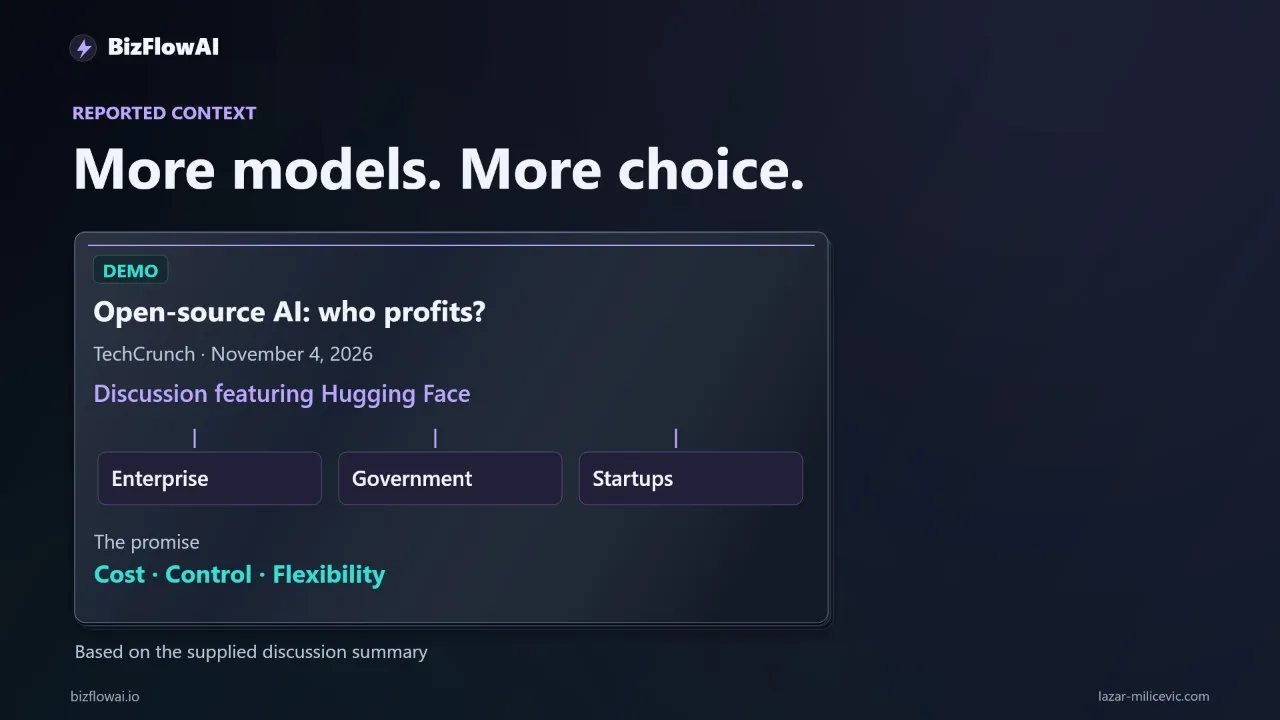
This is the practical question behind TechCrunch’s November 4, 2026 discussion featuring Hugging Face. The discussion covers the economics of open source AI and what startups should consider before building on open models. It does not establish that a particular model will run your customer operations more cheaply or safely. You have to test that against your own work.
Hugging Face Inference Providers offers an OpenAI-compatible chat-completions API, which can reduce the work of connecting a different model. That is an interface convenience, not a guarantee of equivalent behavior. Hugging Face also documents provider-selection options such as :fastest, :cheapest, and :preferred, plus automatic failover under its documented conditions. Routing flexibility is useful, but a fallback provider can change the behavior you need to evaluate.
Start with customer emails, not model demos
The first useful provider-swap artifact is a set of past requests with an expected outcome for each. Use emails you are permitted to process, remove personal information the test does not need, and include cases where the correct behavior is to stop rather than act.
Here’s exactly how I would set up the first pass for a small service business. Pull a manageable set of resolved customer emails and create a comparison sheet. For each message, have someone who understands the workflow record what should have happened before viewing either model’s output. Otherwise, it is too easy to rationalize a plausible but wrong answer.
Cover different failure modes, not just different wording:
- A straightforward request from a clearly identified customer.
- A request with no reliable account identifier.
- An email that asks for a quote but does not authorize a change.
- A change request that requires approval under your process.
- A message containing multiple requests with different next steps.
- A follow-up that depends on information outside the email.
Do not put live credentials, CRM write access, or billing tools in the test. Run both the incumbent model and the candidate against the same input and expected outcome. If the current system supplies account context to its model, supply equivalent context to the candidate; otherwise, you are comparing two different workflows rather than two models.
A useful sheet has columns for the email reference, expected request type, expected customer identifier, expected change, expected approval requirement, each model’s outputs, review notes, and the final judgment. Keep timing and actual charges in separate columns. A quick response that authorizes the wrong account change is not a pass.
This initial set is a screen, not production proof. Its value is that it gives you concrete failures to inspect. When you find one, add similar examples and test again before expanding the candidate’s role.
Make the model return a small, checkable contract
Give both models the same narrow output contract: what was requested, which customer is involved, what change is being discussed, and whether approval is required. Validate that output in your application before it can affect a record or trigger another step.
For this workflow, a candidate response could look like this. The identifiers are synthetic; this is an illustration, not a test result.
{
  "request_type": "quote_request",
  "customer_identifier": "ACCOUNT_EXAMPLE",
  "requested_change": "additional_location",
  "approval_required": true
}
The important field is request_type. If a model changes it to service_change, the application should not quietly proceed because the rest of the JSON looks valid. Schema validity answers “can I read this?” It does not answer “is this the right business decision?”
Hugging Face documents JSON Schema response formats for structured output through Inference Providers. Check support and behavior for the specific model-provider combination you plan to use. Likewise, strict function-calling mode is not supported by every inference provider. An API that accepts a familiar request shape does not promise identical enforcement.
Keep tool execution outside the model. In Hugging Face’s documented function-calling workflow, the application executes a requested function and sends the result back to the model. That is the right place for permissions and approval checks: the model may request an action, but your code decides whether it is allowed.
A small offline checker makes the comparison repeatable. Save expected outcomes and model outputs as JSON Lines files, with a shared case_id in each record. Use this script to compare saved outputs against the expected fields; check its handling of input errors before relying on it in your own test process:
import json
import sys
from pathlib import Path

FIELDS = (
    "request_type",
    "customer_identifier",
    "requested_change",
    "approval_required",
)

def load_cases(path):
    cases = {}
    with Path(path).open(encoding="utf-8") as source:
        for line in source:
            if not line.strip():
                continue
            case = json.loads(line)
            case_id = case["case_id"]
            if case_id in cases:
                raise ValueError(f"Duplicate case_id: {case_id}")
            cases[case_id] = case
    return cases

def check_output(expected, actual):
    if set(actual) != set(FIELDS) | {"case_id"}:
        return "invalid_fields"
    if type(actual["approval_required"]) is not bool:
        return "invalid_approval_value"

    for field in FIELDS:
        if actual[field] != expected[field]:
            return f"mismatch:{field}"

    return "pass"

expected = load_cases(sys.argv[1])
candidate = load_cases(sys.argv[2])

for case_id, answer in expected.items():
    result = candidate.get(case_id)
    status = (
        "missing_output"
        if result is None
        else check_output(answer, result)
    )
    print(f"{case_id}\t{status}")

for case_id in candidate.keys() - expected.keys():
    print(f"{case_id}\tunexpected_output")
Run it against the expected file and one provider’s output file:
python compare.py expected.jsonl candidate.jsonl
Run it again for your incumbent model. The script is intentionally strict: it does not normalize guessed account identifiers, excuse extra fields, or infer what the model “probably meant.” Adjust the contract to your business, but make changes to the checker deliberately and apply them to both providers.
Judge the dangerous errors separately
A provider swap should pass on decision safety, not on an average quality score alone. In this example, the most important failures are matching the wrong customer, treating a quote request as authorization, or failing to stop when approval is required.
Review each mismatch alongside the original message and the context provided to the model. Separate errors into categories you can act on:
| Failure | What to investigate |
|---|---|
| Wrong request type | Was the email ambiguous, or did the prompt blur “quote” and “change”? |
| Wrong customer | Was the identifier absent, conflicting, or inferred from insufficient context? |
| Wrong approval decision | Is the rule missing from the application, or was it incorrectly delegated to the model? |
| Invalid output | Does this model-provider combination reliably support your required format? |
| Correct fields, poor draft | Can drafting be improved without changing the decision boundary? |
Some failures call for a better prompt or clearer account context. Others should not be solved with prompt wording. If the application can determine that agreement changes require approval, encode that rule in the application. Do not depend on the model to remember it on every request.
Keep the test disconnected from live actions while you work through failures. Then expand the set with examples resembling what went wrong. A passing comparison sheet supports a controlled trial with human review; it does not prove the candidate will handle every future customer email.
This is also where provider abstraction earns its keep. Put model-specific request formatting and response parsing behind an adapter. Keep customer lookup, approval rules, audit records, and CRM updates in your application. If replacing the adapter still forces you to rewrite those business steps, your prompts and integrations are too tightly coupled.
Compare operating costs, data handling, and access
A cheaper model call is not necessarily a cheaper or acceptable workflow. Compare actual usage charges, response times, review effort, hosting, and maintenance for the same requests—and check where customer data goes before sending any emails.
Review the Inference Providers pricing documentation for current charges and any available testing allowance. A testing allowance is not a production budget. For requests routed and billed through Hugging Face, its pricing documentation says it charges the provider’s rate without an additional markup. Record the charges you actually incur for your selected provider and workload rather than turning that policy into a savings claim.
Dedicated Inference Endpoints have hourly instance rates with cost calculated by the minute. If you consider a dedicated endpoint, include time the instance is running, not only the time spent generating responses. Scaling to zero can introduce a cold start on the next request. That may be fine for background triage and frustrating for an employee waiting to reply to a customer. Test the configuration you intend to operate.
Data handling needs its own decision. Hugging Face says it does not store request bodies or responses when routing through Inference Providers, and directs users to each inference provider’s security policies. Read the policy for the provider that will handle your requests. Minimize the customer information you send, confirm your permission to use it, and decide what your own application logs retain.
Finally, check the specific model’s terms before calling it “open” or using it commercially. Hugging Face model cards can show license metadata, while gated models may require an access request and author approval. The Open Source Initiative’s warning is captured in its title, “Open Weights: not quite what you’ve been told”: available weights alone do not make an AI system open source.
The result you want is not a claim that one provider wins. It is a documented replacement path: the same customer requests, the same expected decisions, visible failures, measured operating costs, and application-controlled actions. An open model gives your business another option. A tested handoff is what makes that option usable.
Where bizflowai.io fits
At bizflowai.io, I focus on practical AI automation for solopreneurs and small teams. For a provider swap, I recommend building the workflow around the model: define how information moves between business tools, keep approvals explicit, and make routine handoffs traceable. Changing the model should not silently change who can update a customer account or prepare a billing change.
Want more like this?
I’m Lazar Milićević, a senior engineer who builds AI automations.
Visit bizflowai.io to learn more.
Frequently asked questions
What is a provider-swap test for an AI workflow?
A provider-swap test checks whether another model can handle the same business requests without changing the surrounding workflow. The narration suggests comparing a current model with an open-model candidate on past customer emails, using the same output fields and expected answers. Both models should remain disconnected from live actions. The comparison can reveal differences in interpretation before they affect customer records or billing.
How do I test an open model before using it for customer requests?
Start with twenty past customer emails you’re permitted to use, remove unnecessary personal information, and record the correct outcome for each. Include clear, ambiguous, and approval-required requests. Ask your current model and an open-model candidate for the same fields: request type, customer identifier, requested change, and approval required. Compare their answers with the expected outcomes, then expand the test set before considering production use.
Why does model interpretation matter for business workflows?
Two models can produce convincing replies while interpreting the same customer email differently. For example, a request for a quote on an extra location could be mistaken for permission to add that location. In a connected workflow, that mistake could lead to an incorrect account or billing change. Checking the model’s output against business rules and requiring approval for consequential changes helps contain that risk.
When should I use an open model instead of my current AI provider?
Consider an open model when it performs well enough on your actual requests and its measured costs fit your workflow. The narration recommends comparing request identification, customer matching, approval decisions, response time, and usage charges. If you host the model yourself, include hosting and maintenance costs. A twenty-email test is only an initial screen, not proof that switching will save money or work reliably in production.