ChatGPT Business Agents: Is Your Business Ready?
▶ Watch the video version of this article
A customer asks whether your made-to-order desk can arrive by Friday. Your product page gives a standard lead time, but your workshop schedule says the current queue is longer. If a Business Agent answers from the product page alone, it could make a promise your team cannot keep.
OpenAI’s new business presence in ChatGPT makes that problem worth solving—but it does not solve it for you. Before you publish an agent, test whether your business can give ten common questions accurate, source-backed answers and route the rest to a person.
First, separate the profile from the agent
A business profile is a way to manage how your business appears in ChatGPT; a Business Agent is a separate conversation customers can choose to open from that profile. Claiming a listing does not mean an agent is live, and neither feature should be treated as a connection to your operating systems.
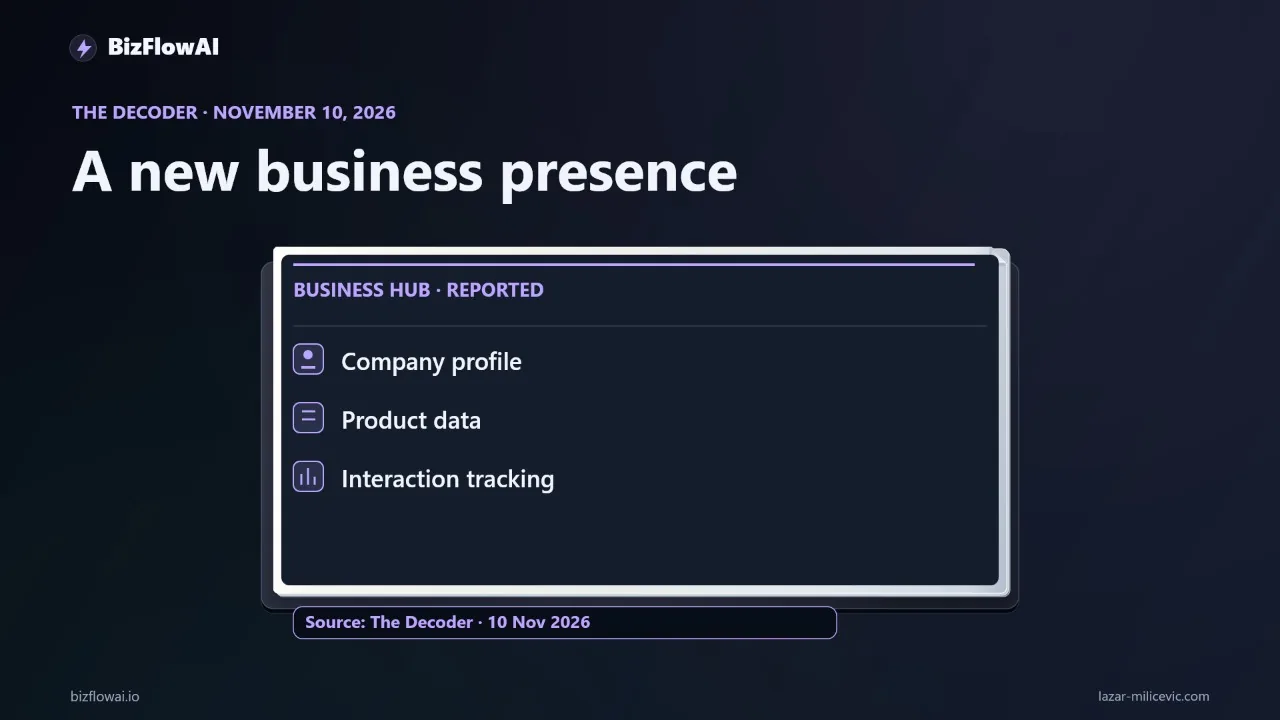
OpenAI announced the Businesses in ChatGPT beta on November 10, 2026. Its Business Hub lets eligible businesses claim a listing, manage business information, and see engagement insights. Claiming is available where ChatGPT is available and the required verification is supported. Business Agents have narrower eligibility: OpenAI’s setup guidance describes eligible US e-commerce and online service businesses with a website, subject to industry requirements.
That distinction matters if you run a local service company, sell outside the US, or manage several brands. Check the eligibility shown for your business rather than planning around an assumed rollout.
The current capability boundary is equally important. According to OpenAI’s setup guidance, a Business Agent can explain products and policies and link to your website. It cannot currently complete purchases, make bookings, or check an order. Its separate chat also does not inherit the data or capabilities of an existing ChatGPT plugin. If a customer asks, “Where is my package?”, publishing an agent does not give it access to your order system.
OpenAI says 1.2 billion people use ChatGPT each week. That is a platform-wide usage figure, not your addressable market or a sales forecast. Claiming a business does not guarantee higher placement or sales. The practical question is whether customers who encounter your business there can get a correct answer.
Build an answer register before writing agent instructions
An answer register is a small table that ties each recurring customer question to an approved answer, its authoritative source, a responsible owner, and an escalation rule. It exposes conflicting information before a customer does—and remains useful across email, website support, and any future agent.
Start with ten real questions from your inbox. Remove customer names, order details, and other personal information. Include a mix of straightforward policy questions and requests that depend on current or private data.
Use these five columns:
| Customer question | Approved answer | Source | Owner | Escalation rule |
|---|---|---|---|---|
| Do you ship to my location? | State only the published shipping coverage. | Shipping policy | Operations | Escalate destinations not listed. |
| Will this desk fit my monitor arm? | Give only confirmed compatibility details. | Product specification | Product owner | Escalate untested models. |
| Can it arrive by Friday? | Explain the published lead time; do not promise a date. | Shipping policy | Operations | Escalate date-specific commitments. |
| Where is my order? | No public-data answer is available. | Order system | Support | Route to the existing authenticated support process. |
| Can you make an exception to the return policy? | Explain the policy without approving an exception. | Return policy | Support lead | Escalate the decision. |
The table’s most important field is source. “The salesperson usually knows” is not a dependable source until that knowledge is recorded and maintained. If a product page and an internal schedule disagree, decide which one governs the answer. Then either correct the stale page or make the question an escalation until the conflict is resolved.
Separate three kinds of information:
- Published facts: Product specifications, shipping coverage, and policies that customers can verify.
- Changing operational facts: Production capacity, stock, and delivery availability that require a current source.
- Customer-specific facts: Orders and account details that require authentication and access to a private system.
Do not turn a changing fact into a fixed agent instruction. A sentence such as “We can usually deliver quickly” is not a control for a date-specific promise. OpenAI’s Business Agents Policy requires businesses to keep information current and prohibits instructing an agent to invent prices or availability.
For the desk shop, the approved answer to “Can it arrive by Friday?” should therefore explain what the published policy says and identify that the requested date needs confirmation. It should not silently replace the workshop schedule with the more convenient product-page estimate.
Run a ten-question test with explicit pass conditions
A useful readiness test asks whether each answer is supported, not whether it sounds helpful. Give your assistant only the approved information in your register, ask the ten questions, and inspect the responses yourself before publishing anything.
Here is a simple test prompt. It is a testing aid, not a claim about how OpenAI’s Business Agent is configured:
Answer using only the approved source material below.

For each customer question:
- State the answer only if the source supports it.
- Do not infer a price, delivery date, availability, order status,
  refund approval, or policy exception.
- If the source does not settle the question, say what is unknown
  and identify the correct human handoff.
- Identify the source used.

Approved source material:
[Paste the relevant, current entries from the answer register]

Customer question:
[Paste one anonymized question]
Record the outcome in three categories: supported answer, correct escalation, or unsupported claim. A correct escalation is a pass when the information is unavailable. A confident answer that happens to sound plausible is not.
Test edge cases deliberately. Ask a routine return-policy question, then ask for an exception. Ask about a published product dimension, then about an accessory you have never tested. Ask for a general delivery policy, then for a guaranteed arrival date. Ask where an order is, even though the current Business Agent cannot check it.
For each response, check the exact claim against the source. Did it turn “standard lead time” into a guaranteed delivery date? Did it present an untested accessory as compatible? Did it imply it had looked up an order? Those are failures even if the tone is polished.
If the agent makes an unsupported claim, do not just reword the prompt and declare the issue fixed. Look for the underlying cause: an ambiguous policy, a stale page, conflicting documents, or no escalation owner. Fix the source or narrow the permitted answer, then rerun the question and its related edge case.
This is also where you decide whether an off-the-shelf setup is enough. If most questions can be answered from stable public information, a carefully maintained information set may cover the job. If customers mostly ask about live capacity or their own orders, the current Business Agent’s limits mean you need a reliable handoff to an existing channel—not an instruction telling it to behave as though it has a connection.
Design the handoff as part of the answer
A handoff works when the customer knows what happens next and the receiving team knows what remains unresolved. “Contact support” by itself makes the customer repeat the question; “Your desk may arrive Friday” risks making an unsupported commitment.
For a date-specific delivery request, the customer-facing answer could be:
“Our published lead time does not confirm arrival by your requested date. Please contact our team through the website with the product and requested delivery date so we can check the current production schedule.”
That answer states the limit without pretending the agent checked an internal calendar. The corresponding internal support process should capture the product, requested date, relevant policy, and unresolved decision. Build that process in a channel you control; do not assume the Business Hub supplies an integration or forwards the Business Agent chat to your team.
A small, reusable handoff record might look like this:
handoff_type: delivery_date_request
product: "made-to-order desk"
requested_date: "customer-provided date"
approved_source: "published shipping policy"
unresolved_question: "Can the current workshop schedule meet this date?"
decision_owner: "operations"
customer_next_step: "submit the request through the website"
This is an example schema for your own workflow, not a Business Agent feature. It gives a support person enough context to make a decision without instructing the agent to invent one.
Keep private data out of the public-answer register. For order-status questions, direct customers to your authenticated support or order process. Do not ask them to paste sensitive account information into an agent conversation merely because it is convenient.
Publish deliberately, then measure what the Hub shows
Publishing should be a controlled release: verify the business, review the information, test the agent, and explicitly publish it if eligible. Afterward, use Business Hub insights as limited engagement signals—not as proof that answers were correct or that sales increased.
OpenAI’s setup guide says available claim-verification methods can include phone, business email, website domain, or Shopify. A business does not need an Ads account or a ChatGPT Enterprise agreement to claim an eligible listing.
Claim approval is not the final gate. OpenAI says Persona identity verification must also be approved before a business can publish information changes, view insights, connect a product feed, or create an eligible Business Agent. Claiming alone does not add the blue verified badge; that follows approved Persona verification. An eligible business must then review and separately publish its agent before customers can chat with it.
Set an owner for every published policy and product-data source. When a shipping rule, specification, or availability statement changes, that owner should update the authoritative source and rerun affected test questions. OpenAI’s terms make the business responsible for testing an agent it enables or publishes, including accuracy and safety.
Business Hub insights include aggregate mentions and website clicks over the past 28 days. Businesses do not receive individual prompts or Business Agent chats through those insights. A blank metric does not necessarily mean zero activity; reporting may be below a threshold, still collecting data, or unavailable. You cannot use the Hub alone to audit every answer a customer received.
So keep two separate checks. Use Hub insights to observe the engagement information OpenAI provides. Use your own ten-question test and source-change process to check answer quality. One measures limited visibility; the other tests whether the system is safe to rely on.
Where bizflowai.io fits
At bizflowai.io, my work is building practical AI automations for solopreneurs and small teams. For this kind of project, the useful starting point is the answer register, source ownership, and a human handoff—not another conversational interface pretending it can see systems it cannot access. That foundation is reusable whether customers reach you through your website, email, or a published Business Agent.
Want more like this?
Learn more at bizflowai.io.
Lazar Milićević is a senior engineer who builds AI automations.
Frequently asked questions
What is OpenAI’s Business Hub?
According to The Decoder’s November 10 report, OpenAI’s Business Hub lets companies claim a business profile, add product data, and track how users interact with their business. A profile gives a company a presence; it is separate from a Business Agent, which adds a way to answer customer questions inside ChatGPT.
When should I use a business profile vs a Business Agent?
A business profile is for establishing your company’s presence and adding product information. A Business Agent adds a conversational layer for answering customers inside ChatGPT. The reported agent offering is for eligible US e-commerce providers, so access should not be assumed for every business. The supplied summary also does not establish that agents can complete purchases, issue refunds, or update other systems.
How do I prepare my business information for an AI customer assistant?
Create a spreadsheet with five columns: customer question, approved answer, source, owner, and escalation rule. Add ten recurring questions from your inbox after removing names and personal details. Identify the source that settles each answer, then test an AI assistant using only that approved information. Review its responses and record supported answers, unsupported claims, and correct escalations separately.
How should an AI assistant handle conflicting delivery information?
An AI assistant should use the source that reflects the current delivery situation rather than make a promise from an outdated product page. For a made-to-order item, that may mean checking the current production schedule. If it cannot access that schedule, it should explain the published lead time and pass the date-specific question to a person without inventing a delivery commitment.
Why do authoritative sources and human handoffs matter for AI customer support?
A conversational interface cannot resolve conflicting policies, spreadsheets, and staff estimates on its own. A business needs to decide which source governs each answer and how that source stays current. When the information cannot settle a request, the assistant should escalate it with useful context, such as the product, requested date, and unresolved question, so the customer does not have to start over.